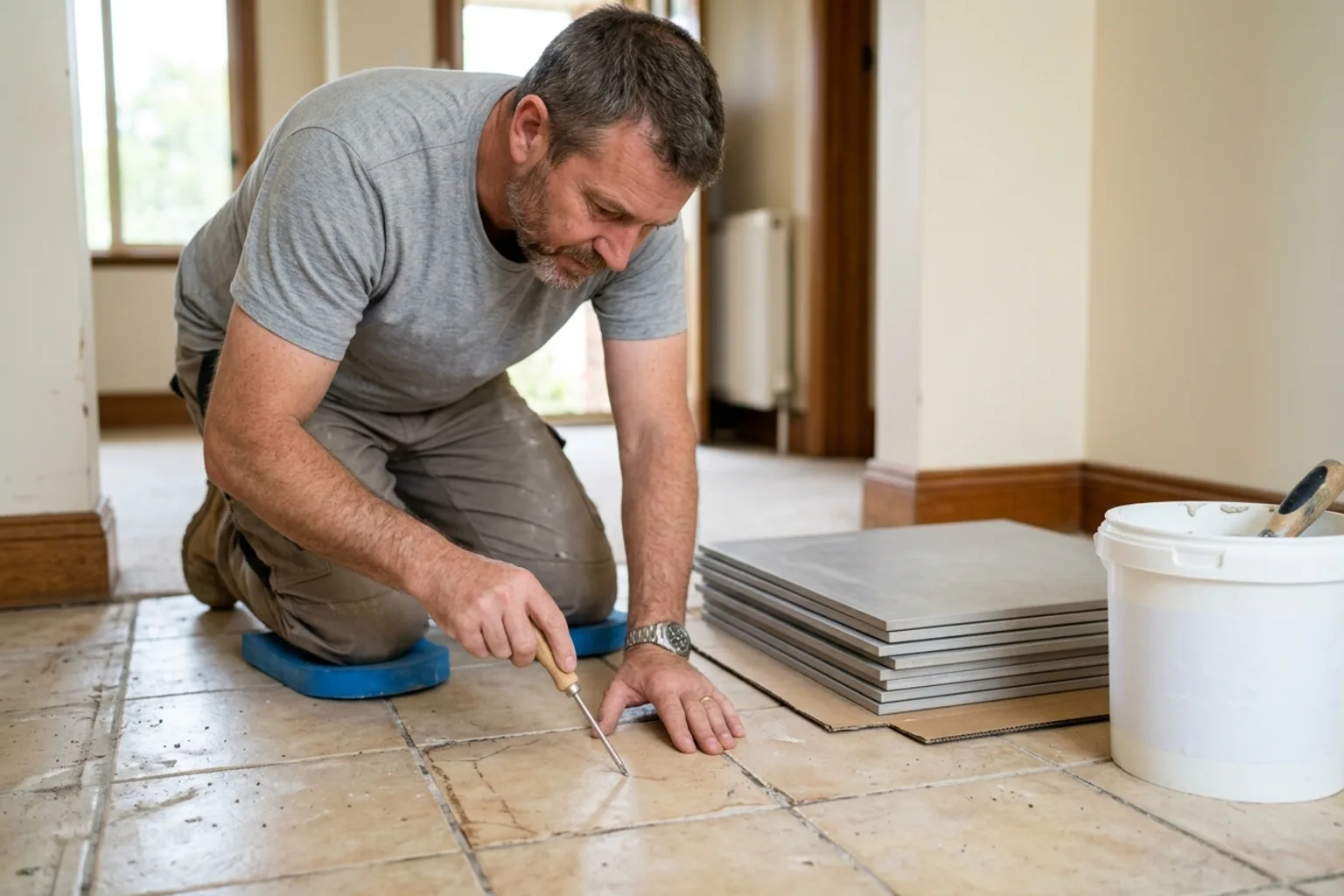
Two jobs in the same fortnight, both people asking the same thing: can you just go over the top of what is there. The first was a laundry at Corrimal, old 200 by 200 beige floor tiles, dead flat, not a hollow one in the room, and a door that swung inward with a good 20 millimetres of daylight under it. We went over. Half a day of tiling, no dust, no skip bin, and the owner used the laundry that night on a board across the doorway.
The second was a bathroom at Albion Park with the same tiles and the same question. That one we stripped, and the owner was not thrilled about it until I showed her why. Same tiles, opposite answer. So here is how the decision gets made, because it is not a matter of taste.
What has to be true before we go over
Three things, and all three, not two out of three.
The old tiles have to be stuck. That is the knuckle test from the regrout or retile post, run across the whole floor rather than the bit you can see. A hollow, drummy tile has already let go of its bed, and whatever we bond to it goes with it when it finally lifts. One drummy tile in a corner can be cut out and made good. A patch of them under the vanity means the bed has failed and there is nothing to build on.
The surface has to be flat. Not level, flat. Old floors in the Illawarra fall towards a drain or towards nothing in particular, and that is fine, tiles can follow a fall. What they cannot do is bridge a hump or a dip, because the new tile spans it and cracks or rocks. A straight edge across the floor in a few directions tells you in two minutes.
And there has to be somewhere for the extra height to go. This is the one people never think about and it is the one that stops the most jobs. Tile plus adhesive adds something like 10 to 15 millimetres. Every door into the room has to clear that. The threshold to the next room now has a step in it. The toilet pan sits lower relative to the floor, the vanity kickboard shortens, the shower screen channel is now buried. In a laundry with one door and a lot of clearance, none of that matters. In a bathroom with a toilet, a screen and a door that already brushes the mat, all of it does.
The Albion Park bathroom failed on the third one. The door would have needed cutting, the pan would have needed lifting to sit on the new floor, and lifting a toilet is a plumber's job in NSW at any price, not ours. Strip and retile ended up simpler and not much dearer.
Floors are easier than walls, walls are easier than showers
On a floor the tile is doing one job, sitting there. Going over an old floor is mostly a prep question: degrease it properly, because twenty years of mop-and-bucket leaves a film that adhesive will not grab, then a primer made for going over glazed surfaces, then a flexible adhesive rather than the cheap bag. Skip the primer and the new floor peels off in a sheet a year later. I have seen it done, and I have been the one called to fix it.
Walls are the same prep with one more worry, which is weight. Old wall tiles on old plasterboard are already carrying a load. Doubling it on a wall that is sound is fine. Doubling it on a sheet that has gone soft behind a basin is asking for the lot to come off in your hand. The splashback post goes through why we usually strip splashbacks, and the thickness problem there applies to any wall with fixed joinery against it.
Showers are where I get cautious, and it is not the tiles. It is what is under them. A shower that has been leaking into the wall next door does not stop leaking because you put a second layer of tile over it. The membrane under the old tiles is what keeps the water in, and if that has failed, tiling over it buries the problem where nobody will see it until the skirting in the hallway swells. Going over in a shower only makes sense when the existing waterproofing is sound and the reason for the job is purely how it looks. If there is any sign of moisture getting through, it is a strip-back, and new waterproofing is its own licensed trade category in NSW. The waterproofing work page puts it under the same $5,000 contractor-licence test as other trade work, and it is not something we do at any value. We regrout and reseal existing wet areas. We do not put a new membrane in.
The one time going over is actually the safer option
Older houses, roughly anything built before 1990, often have tiles fixed to fibre cement sheet, and some of that sheet contains asbestos. SafeWork NSW lists wall sheeting behind tiles as one of the asbestos hazards inside a home, along with vinyl floor tiles and their adhesive. Stripping tiles off that sheet tears it, and torn asbestos sheet is a different job with a different set of rules. SafeWork says a licensed asbestos professional must remove any amount of the friable kind, and anything over 10 square metres of the bonded kind.
So in a 1970s bathroom at Warrawong or Berkeley, the argument can flip. Leaving the old tiles and the sheet behind them undisturbed and going over the top means nobody cuts, drills or scrapes the sheet at all. That is not us being lazy, it is the right call. We still need the three conditions above to hold, and if they do not, the removal needs the right people rather than us with a chisel.
What it costs, in the way we quote it
We price tiling by the half-day, and going over saves roughly the first one. A strip-out on a small bathroom is a half-day to a day of noise and dust, plus a skip, plus making good the wall or floor that came off with the tiles. Going over skips all of that. So on a job where it is a fair option, the saving is real. Where it is not a fair option, the saving is a loan you pay back when the second floor comes up.
Wall and floor tiling in NSW sits under the $5,000 threshold like other trade work, so a laundry floor, a splashback or a small bathroom retile on its own is the size of job we take on. The tiling page and the bathroom tiling page have what we do and do not do. If you want the answer for your room, send a photo of the floor, the doorway with the door open, and anything hollow you have found with a knuckle, and we will tell you whether it goes over or comes up.
Want a hand with this at your place? Get a free quote or call 0450 959 936.