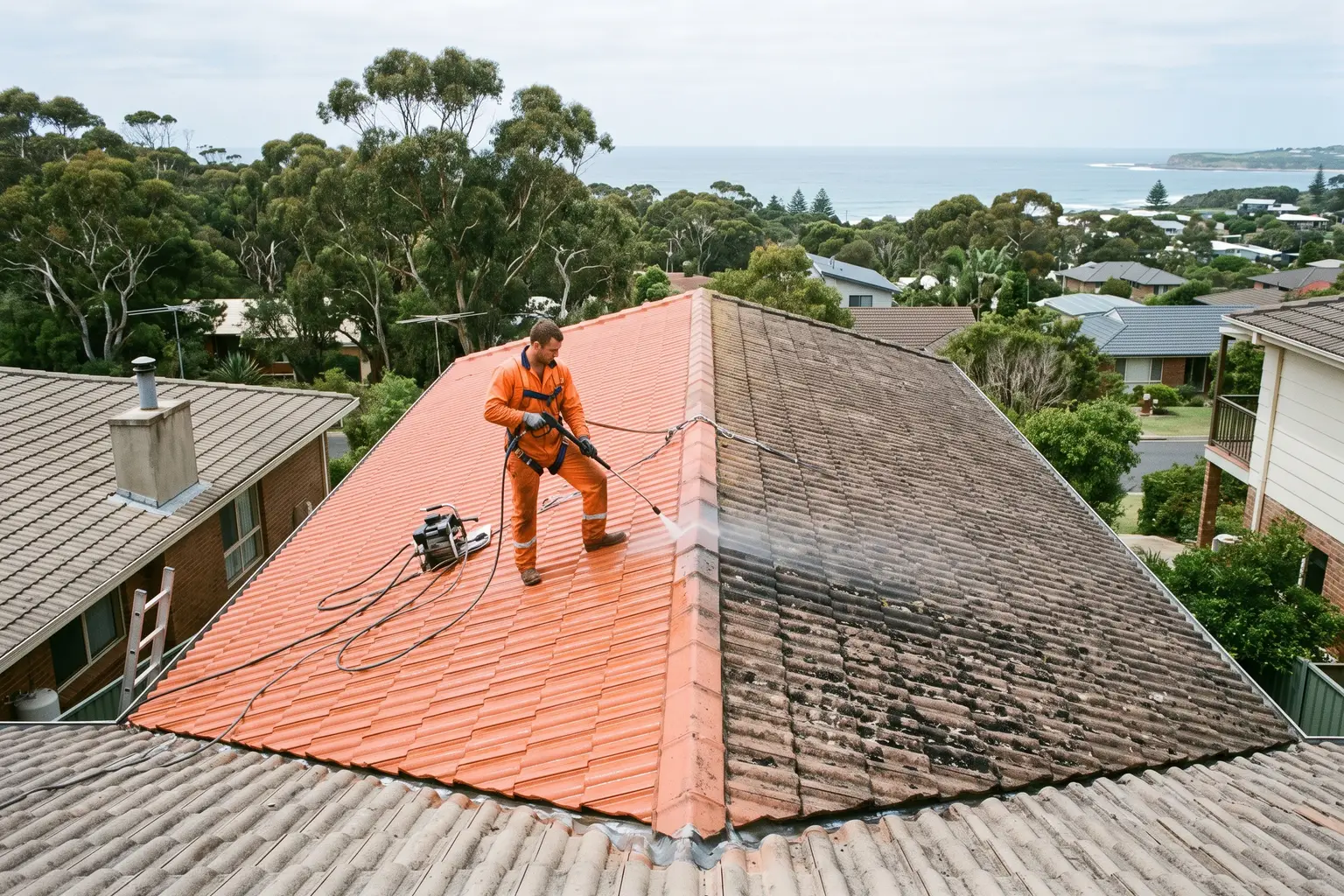
The owner of a holiday let at Ulladulla had three quotes for a roof restoration on the kitchen bench and rang me because none of them described the same job. One was a clean and paint. One was a clean, repoint and paint. One had a line for re-bedding, a line for tile replacement and a line for something called a sealer coat, and it was twice the price of the first. She wanted to know whether she was being ripped off by the third or short-changed by the first.
The answer was neither, quite. The word restoration does not mean anything fixed. It covers whatever the person quoting decided to include, and the cheap version leaves out the parts that make the expensive version last. So this is what the job is when it is done properly, which parts you can drop, and the two situations where a restoration is the wrong thing to spend money on at all.
What does a roof restoration include?
A full restoration on a tiled roof is four stages done in order: a high pressure clean back to bare tile, repairs to the ridge capping and to any broken or slipped tiles, a sealer or primer coat, then two coats of a roof membrane paint. The order matters more than the brand of paint, because every stage exists to make the next one stick.
- The clean strips lichen, moss, salt and the chalky surface off old concrete tiles. On the sea-facing pitch of a house at Milton or Kiama that layer is thick, and paint put over it lifts within a season.
- Capping repairs are the part that gets skipped. Bedding mortar that has cracked gets re-bedded, joints get repointed with flexible pointing, and cracked or slipped tiles get swapped. The repointing versus re-bedding post covers how to tell which one your capping needs.
- The sealer binds a porous tile surface so the topcoat goes on evenly. Skipping it on old concrete tiles is why some restorations look patchy from the street inside a year.
- The membrane coats are the visible part. Two coats, applied in dry weather, over a roof that is clean and repaired underneath.
The first of those Ulladulla quotes was stage one and stage four. It would have looked good in the listing photos and started peeling around the second winter.
Cleaning on its own is a real job too
Not every roof needs the whole thing. If the capping is sound and the tiles are terracotta rather than concrete, a clean is often all the roof needs, because glazed terracotta does not chalk and does not take paint well anyway. We do a fair amount of standalone roof cleaning down the coast for exactly that reason, usually bundled with the exterior wash before a sale or a repaint.
What a clean will not do is seal anything. If a concrete tile roof has gone porous, washing it makes it look better for a while and then the moss comes back, because the surface is still soaking up water. That is the roof telling you it wants the sealer and the coat.
When a restoration is the wrong fix
Two situations, and they are the ones where people lose the most money.
The first is a roof that is already leaking. Paint does not fix a leak. The water is getting in at a cracked tile, a failed valley, a broken capping joint or a flashing, and a membrane coat over the top does nothing for any of those. The repairs are the fix; the coat is cosmetic. If you have stains on a ceiling, get the roof repairs done and looked at first, and decide about the coat afterwards when the roof has been through some rain. The roof leak signs post is the checklist for what to look for from the ground.
The second is a roof where the tiles themselves have gone. Concrete tiles that are fretting, meaning the surface crumbles under your thumb, or terracotta tiles that have delaminated in the frost, are not going to be saved by a coat of paint. A restoration on that roof is money spent on a surface that is coming off. That is a re-roof, it is a licensed contractor's job in NSW, and we will tell you so rather than sell you a coat.
There is a third, smaller case: a metal roof. A Colorbond or corrugated iron roof can be restored, but it is roof plumbing work in NSW and a different trade from tiling, so it goes to a roof plumber. We do not quote it.
Where our part of the job stops
We work on concrete and terracotta tile roofs, and we work on them where the whole job sits under the NSW contractor-licence threshold. NSW is clear about the figure on its roof tiling work page: a contractor licence is needed for residential trade work, including roof tiling, valued at more than $5,000 in labour and materials including GST. The same page lists tile bedding and pointing as roof tiling work, which is why the capping repairs are ours.
A full four-stage restoration on a large roof can cross that figure. When it does, it needs a licensed contractor and we will say so rather than split the job into a clean this month and a coat next month to stay under. Plenty of restorations on an ordinary single-storey roof do not cross it, and a clean, capping repair and coat on a smaller holiday place is exactly the size of job we take on.
Metal roofing, gutters, downpipes and flashings are roof plumbing, a separate trade category with its own qualification, and NSW applies the same $5,000 threshold to it. We do not work in that trade at any value. If your restoration turns out to need new gutters, that part goes to a roof plumber and the rest can still be ours.
Timing it on the coast
Restorations want dry weather and a few days of it. Down the coast that means spring and autumn are the sensible windows; summer is fine but the afternoon storms make the coats a gamble, and winter mornings leave the roof wet until lunch.
For a holiday let the timing is set by the bookings rather than the weather, and the job has to be finished, dry and off the roof before the next changeover. We schedule the Ulladulla and Milton work that way, which usually means a clean and repairs midweek and the coats the following week. If you want the honest version of what your roof needs, send us a photo of the capping and the worst pitch and we will tell you whether it is a clean, a restoration, or a repair job first.
Want a hand with this at your place? Get a free quote or call 0450 959 936.