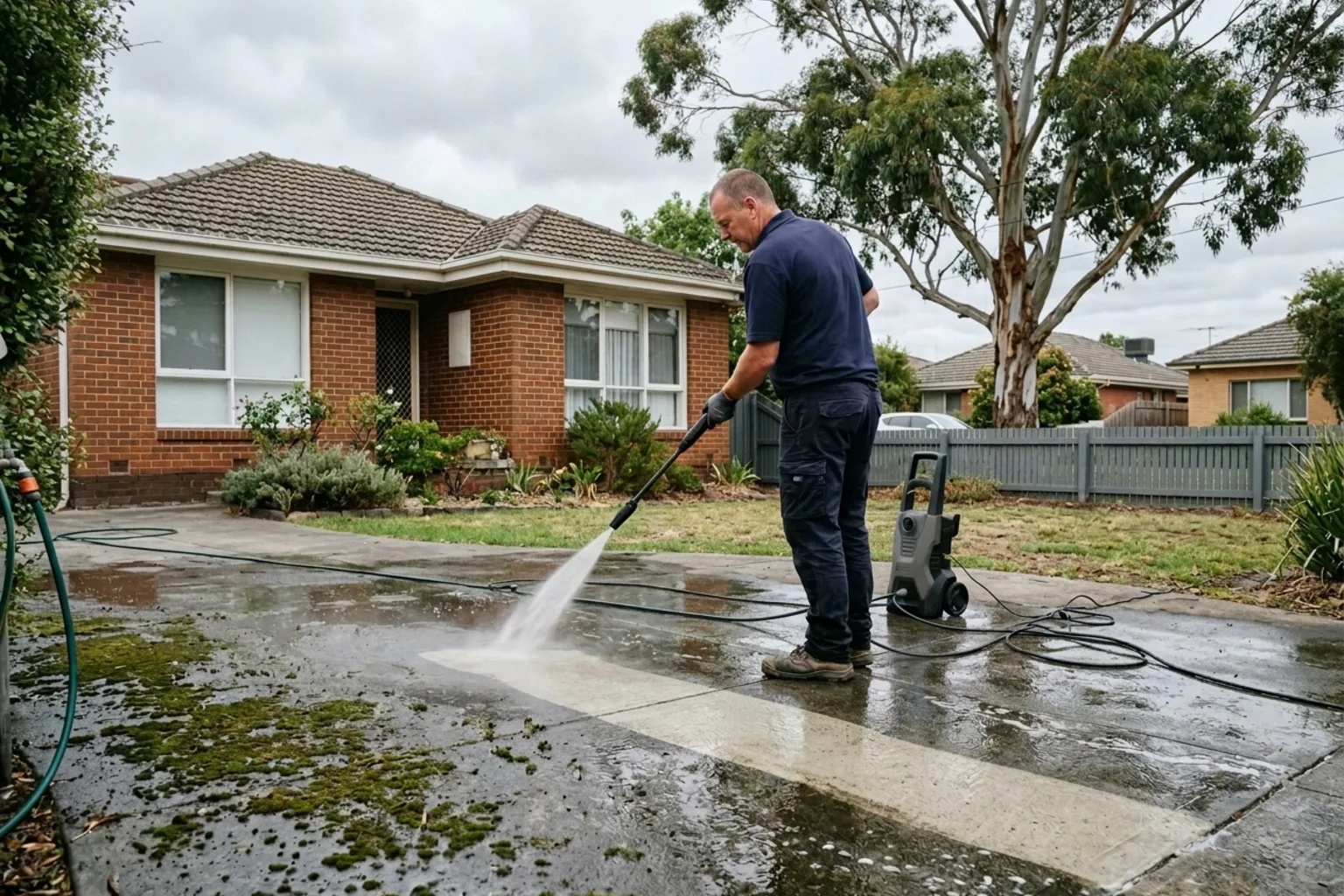
The driveway at Figtree ran up the south side of the house, under a big gum, and it was black from the letterbox to the garage. The other half, the side that got afternoon sun, was the normal grey of a 30-year-old concrete slab. The owner thought the dark side had been stained by something. It had not. It was alive.
That is the first thing to get straight about a driveway that has gone dark. It is not dirt, it is growth. Algae, moss and lichen, living on the damp concrete because that side of the house never dries out. A hose and a broom do nothing to it because you are not sweeping dirt, you are trying to sweep a lawn. A pressure wash strips it, and the difference between the two halves of that Figtree driveway disappeared in about three hours.
Concrete, pavers, exposed aggregate and sandstone are four different jobs
Plain concrete takes the most pressure and gives the best result. It is the surface where a wash looks like a magic trick, the dark comes off in a clean stripe and the slab underneath is a colour the owner has usually forgotten. The only catch is the surface cleaner attachment, the flat round hood on the end of the machine. Without it you get the wand stripes everyone has seen on a driveway someone did themselves, light and dark bands running the way the person walked. The hood cleans a wide even path and it is most of why a professional job looks different.
Pavers come up nearly as well, with one problem. The joints are filled with sand, and a pressure washer blasts it out. Do the whole driveway and you have a clean set of pavers sitting loose with nothing between them, and they start to rock and creep within a few months. So a paver job is a wash, a dry, and then re-sanding the joints, swept in and compacted. Skip the re-sand and the clean driveway is a worse driveway than the dirty one was. If pavers are already lifting or sunk into a puddle before we start, that is a relaying job and it gets said so up front, because washing does not put them back.
Exposed aggregate is the one that gets damaged by the weekend hire machine. The stones sit in a matrix that is softer than they are, and too much pressure too close plucks the small ones out and leaves a pitted patch that never goes back. It wants lower pressure, more distance and more passes. Slower, but it is the difference between a clean drive and a scarred one.
Sandstone is softer again and it etches. Old sandstone paths and steps around Kiama and Gerringong come up well, but you treat them like a painted wall, not a slab. Low pressure, more chemistry, let the moss killer do the work and rinse. Anyone who quotes a sandstone path at the same rate and method as a concrete driveway has not done one.
The stains that are not going anywhere
Oil is the one people expect to vanish and it does not. A fresh drip from a car will lift with a degreaser and a wash. An oil patch that has been there since the last car, soaked a few millimetres into the concrete, will fade and stay. We tell people that before the job, not after, because otherwise the clean driveway with the one dark shadow on it reads as a job that failed.
Rust marks from a metal pot or a bit of reo showing through are the same. Tannin from gum leaves and nuts sitting on the slab all winter usually goes with the wash, sometimes needs a second go. And the white haze that comes up on pavers and some concrete after a wash is efflorescence, salts coming out of the material as it dries, and it can look like the wash left a residue when it is actually the slab breathing. It brushes off dry a week later.
None of this is a reason not to wash. It is a reason to know what the surface will look like when it dries, which is not what it looks like wet.
Where the water goes
This is the part I actually care about and most weekend jobs get wrong. Everything the wash lifts, the moss, the algae, the detergent or moss treatment we used to loosen it, the grit, goes downhill with the water. On most driveways downhill is the gutter and the stormwater grate in the street, and stormwater in NSW is not treated. It goes to the nearest creek and out to sea at the beach where your kids swim.
The NSW EPA's water pollution page defines pollution broadly enough to cover it: it includes placing any matter where it might fall, descend, be washed or be blown into any waters. A driveway full of green sludge and detergent pointed at a street grate is exactly that. The house washing post covers the same problem for walls.
What we do about it is not complicated. Sweep and bag the loose growth before the wash so there is less to carry. Use the least chemistry that works, and on most plain algae that is none, just pressure and hot water. Direct the runoff onto lawn or garden where the soil deals with it. Where the driveway falls straight to the street with nowhere else for the water to go, we put a bund or a rolled towel across the bottom and sponge or vacuum the worst of it rather than let it run. It adds half an hour. It is the half hour that separates doing the job and doing it properly.
How often, and when
The sunny side of that Figtree drive will not need doing for years. The shady side under the gum will be going dark again in 18 months to two years, and that is normal for the south side of anything in the Illawarra. Once a year on the shaded run is reasonable if it bothers you, every two years if it does not. The escarpment suburbs, Mount Kembla, Mount Keira, anything up the hill at Thirroul, are damper and greener and lean towards the yearly end.
Timing wise, the surface has to be dry to seal afterwards if you want to seal, and a sealer on plain concrete does slow the growth coming back. We quote driveways by the half-day, most single driveways with the paths and a patio are one half-day, a paver job with the re-sand is usually a full day because the joints have to dry before the sand goes in. Before a sale it is the first thing on the list from the preparing a house for sale post, and it is the cheapest visible change on the property.
What is not ours
Cracked or sunken concrete does not wash out and we do not repair slabs, that is a concreter. A driveway that ponds because the fall is wrong or a drain is blocked underneath is a drainage problem, and drainage is licensed plumbing work in NSW at any value, so it goes to a plumber rather than us with a machine. And a timber deck is not a driveway, it does not take driveway pressure, and the deck page is the one for that.
The rest, driveways, paths, patios, pavers and the sandstone steps, is on the exterior cleaning page. If you want to know whether the dark patch is growth, a stain or something wrong with the slab, get in touch with two pictures, one taken dry and one after you have run the hose over it. The difference between those two shots usually tells us which it is, and whether a wash is going to do anything for it.
Want a hand with this at your place? Get a free quote or call 0450 959 936.